Coastal fog in Ocean Beach and Pacific Beach creates damp morning turf where fleas thrive, while warm inland slopes in Rancho Bernardo and Scripps Ranch harbor western black-legged ticks inside drying scrub oak. Yards…
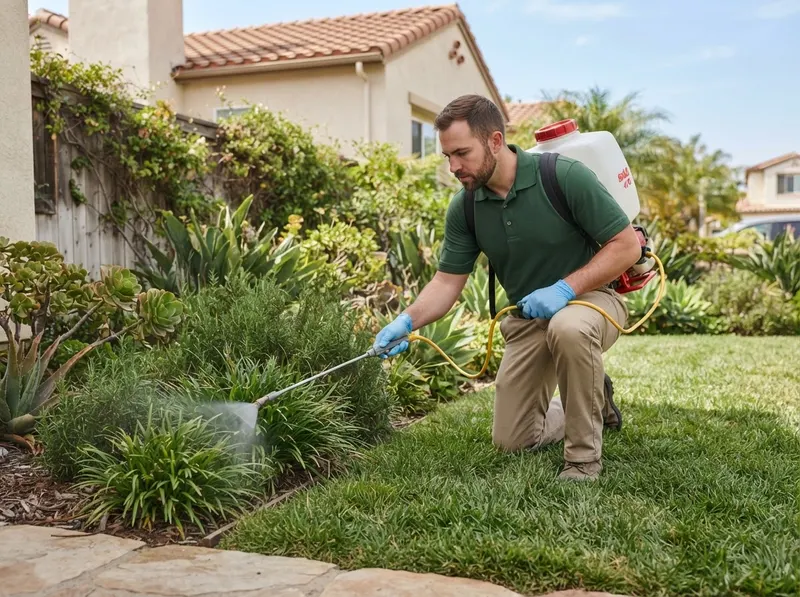
Coastal fog in Ocean Beach and Pacific Beach creates damp morning turf where fleas thrive, while warm inland slopes in Rancho Bernardo and Scripps Ranch harbor western black-legged ticks inside drying scrub oak. Yards bordering natural municipal corridors near Torrey Pines State Natural Reserve or Tecolote Canyon regularly absorb wildlife carriers such as raccoons, opossums, and mule deer that drop parasites directly into exterior family living zones. Broad-spectrum broadcast spraying often fails because flea pupae remain protected inside dense cocoons buried beneath organic soil layers, while adult ticks climb the stalks of invasive wild mustard to latch onto passing family pets.
Targeted elimination uses an insect growth regulator (IGR) paired with a microencapsulated adulticide applied directly to shaded moisture pockets, crawl space entries, and patio perimeters. If a yard contains heavy coastal clay soil with low drainage in Clairemont or Point Loma, the treatment focuses on moist crawl sub-structures and shaded dog runs where larvae cluster, whereas rocky decomposed granite slopes in Carmel Valley require concentrated applications along brush interfaces where chaparral wildlife enters the perimeter. The trade-off between targeted barrier applications and routine property-wide broadcast spraying involves initial application focus: targeted spot management limits chemical drift near sensitive canyon ecosystems and preserves beneficial pollinators, but requires establishing dry 2-hour exclusion zones while residual active ingredients settle onto soil particles.
Properties in historic districts such as North Park and Hillcrest frequently feature elevated redwood patio decks and unpaved storage corridors that shelter breeding strays. For elevated decking, technicians utilize directional horizontal spray wands to penetrate underneath wood joists without staining finished cedar, whereas open acreages near Old Town San Diego State Historic Park require sweeping ground-layer treatments across exterior stone hardscapes. Step one begins with a physical soil and boundary mapping to flag wildlife paths. Step two involves precision misting applied beneath the 36-inch shrubline where ticks seek hosts. Step three seals the ground perimeter with an insect growth regulator to disrupt larval molting cycles for up to 90 days. Every quote requires an on-site property walkthrough to calculate actual square footage, shaded exposure, and organic matter depth.
Every job gets a firm, written price after a free on-site visit.
Tell us about your targeted flea and tick yard elimination job in San Diego and we'll send a clear, written quote, usually the same day.
 Canyon Finch Pest Control