Coastal Southern California hosts an interconnected subterranean mega-colony of Argentine ants (*Linepithema humile*) alongside native carpenter ants (*Camponotus vicinus*), creating distinct structural risks across…
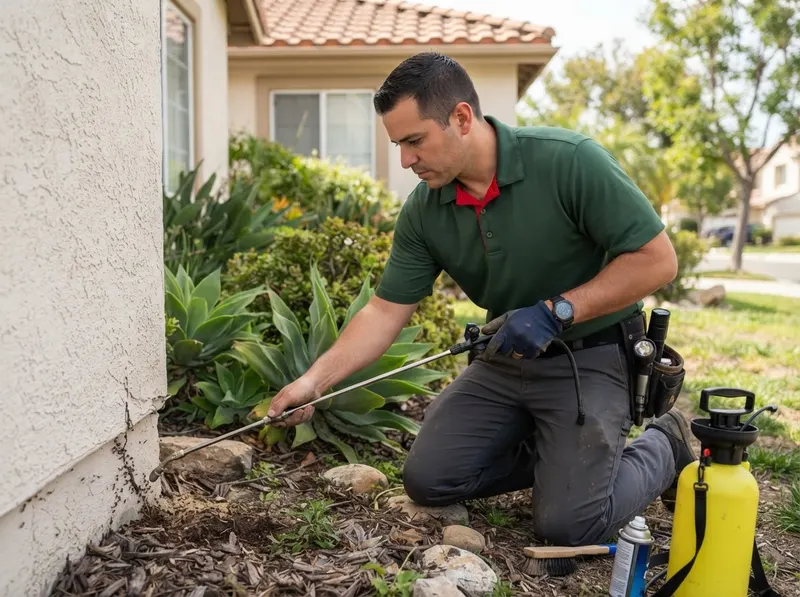
Coastal Southern California hosts an interconnected subterranean mega-colony of Argentine ants (*Linepithema humile*) alongside native carpenter ants (*Camponotus vicinus*), creating distinct structural risks across San Diego neighborhoods. In steep canyon corridors like Tecolote Canyon in Clairemont or the coastal ravines of La Jolla and Point Loma, hot inland winds drive worker ants out of dry brush and directly through the 3/8-inch weep screed perforations in residential stucco. Homeowners in older North Park and Hillcrest Craftsman bungalows frequently confuse sawdust-like wood shavings (frass) beneath subflooring for drywood termite activity, when it actually signals carpenter ants carving smooth tunnels through framing timbers. Standard over-the-counter pyrethroid sprays trigger Argentine ant budding, a defensive biological response where one supercolony splits into 5 to 10 satellite colonies overnight, each containing fertile queens that repopulate interior drywall voids.
Eradicating these colonies requires an architectural approach rather than broadcast surface chemicals. Carpenter ants nest in moist wall framing near roof flashings or plumbing stacks, while Argentine ants exploit utility penetrations, irrigation valve boxes, and foundation expansion joints. In canyon-rim properties across Scripps Ranch, Carmel Valley, and Rancho Bernardo, treatments combine undetectable liquid bait matrixes with targeted borate micro-dust applications placed directly inside hollow baseboards and wall voids. Foraging workers ingest the delayed-action active ingredients, carrying them back across trail distances exceeding 100 feet to feed queens and larvae through trophallaxis. This system neutralizes the reproductive core without saturating soils where family dogs run or triggering pesticide runoff into sensitive coastal watersheds like Mission Bay Park.
The service sequence begins with a multi-point exterior inspection to trace active scent trails from perimeter tree canopies down to foundation cold joints. Next, non-repellent formulations are injected into exterior moisture gaps and wall voids, avoiding standard repellent barriers that cause colony fracturing. Finally, structural entry points are mechanically sealed using copper mesh and elastomeric caulking to stop future migrations from nearby chaparral. A targeted single-colony treatment fits smaller 1,200-square-foot Pacific Beach and Ocean Beach beach cottages, whereas larger multi-level canyon homes require tiered bait networks to counter deep ground nests. The trade-off centers on treatment speed versus colony stability: rapid knock-down sprays kill visible foraging workers within 15 minutes but leave the egg-laying queens untouched, whereas delayed non-repellent eradication takes 7 to 14 days to fully extinguish multi-queen nests without forcing satellite budding.
Every job gets a firm, written price after a free on-site visit.
Tell us about your argentine and carpenter ant colony eradication job in San Diego and we'll send a clear, written quote, usually the same day.
 Canyon Finch Pest Control